

CSC2 Braindumps PDF, CSI CSC2 Exam Cram
New 2026 CSC2 Sample Questions Reliable CSC2 Test Engine
CSI CSC2 Exam Syllabus Topics:
| Topic | Details |
|---|---|
| Topic 1 |
|
| Topic 2 |
|
| Topic 3 |
|
| Topic 4 |
|
| Topic 5 |
|
| Topic 6 |
|
| Topic 7 |
|
NEW QUESTION # 19
What is unique to responsible investment?
- A. It bases investment decisions exclusively on environmental factors.
- B. It is unavailable with certain asset classes like segregated fundi
- C. A combination of a values and valuation-based approach to investing
- D. ESG factors are standardized across the investment no industry.
Answer: C
Explanation:
Responsible investing (RI) incorporatesenvironmental, social, and governance (ESG) factorsinto investment decisions. This approach combinesvalues-basedinvesting (aligning investments with personal or institutional ethics) andvaluation-basedinvesting (analyzing ESG factors to assess potential risks and returns).
* A. It is unavailable with certain asset classes like segregated funds: RI is increasingly available across various asset classes, including segregated funds.
* B. ESG factors are standardized across the investment industry: ESG standards vary and are not uniformly applied.
* D. It bases investment decisions exclusively on environmental factors: RI considers environmental, social, and governance factors, not just environmental concerns.
NEW QUESTION # 20
Which vehicle is least appropriate for an institutional investor?
- A. University endowment
- B. Dark pool
- C. Family office
- D. Discount broker
Answer: C
NEW QUESTION # 21
In a multi-mandate managed account, who sets the overall optimal asset mix?
- A. Overlay manager
- B. Client
- C. Investment advisor
- D. Sub-advisor
Answer: A
NEW QUESTION # 22
The principle of retraction in retractable preferred shares is identical to what other security?
- A. Retractable bonds and debentures
- B. Redeemable preferred shares.
- C. Retractable common shares
- D. Callable preferred shares.
Answer: A
Explanation:
The principle of retraction in retractable preferred shares allows the shareholder to force the issuing company to redeem the shares for cash at a predetermined price on or after a specified date. This feature is identical toretractable bonds and debentures, which give the bondholder the option to require the issuer to repay the principal before maturity.
* A. Callable preferred shares: Callability benefits the issuer, not the holder, and is not similar to retraction.
* B. Retractable common shares: Such securities are not common in the market and are not comparable to retractable preferred shares.
* C. Redeemable preferred shares: Redemption is at the issuer's discretion, unlike retraction, which is at the holder's discretion.
NEW QUESTION # 23
A client who seeks advice from an investment advisor but does not require financial planning guidance.
Which platform is most appropriate for this client?
- A. Self-directed brokerage.
- B. Exchanged-traded fund.
- C. Family office
- D. Discount brokerage.
Answer: D
Explanation:
Adiscount brokerageis an ideal platform for clients who seek professional advice but do not require comprehensive financial planning. Discount brokers allow clients to trade securities with minimal fees, offering tools and resources for investment decision-making without the cost of full-service advisory.
* Why This Platform is Appropriate:
* Clients retain control over their portfolios but can access limited advisory services when needed.
* Suitable for investors who are comfortable with self-directed investing and require occasional guidance.
* Why Other Options Are Incorrect:
* A: A family office provides high-end services, including financial planning, making it excessive for this client.
* B: A self-directed brokerage is entirely self-managed, without access to advisory support.
* C: ETFs are an investment product, not a platform.
References:
* CSC Volume 2, Chapter 25: Overview of Fee-Based and Discount Brokerage Accounts.
NEW QUESTION # 24
What industry stocks tend to have lower betas than the market?
- A. Automobiles and components
- B. Utilities
- C. Capital goods
- D. Transportation
Answer: B
Explanation:
Beta is a measure of a stock's volatility compared to the overall market. Stocks with lower betas tend to experience smaller price fluctuations relative to the market.
* Utilities:Utility companies generally have stable and predictable revenue streams because they provide essential services like electricity, water, and gas, which are always in demand regardless of economic cycles. As a result, utility stocks have lower betas, reflecting their lower sensitivity to market movements.
* Why Other Options Are Incorrect:
* A. Transportation: Stocks in this sector are more sensitive to economic changes and fuel prices, leading to higher betas.
* B. Capital Goods: This sector involves investments in industrial equipment and machinery, which fluctuate with economic cycles and have higher betas.
* D. Automobiles and Components: This industry is cyclical and highly dependent on economic trends, leading to higher betas.
References:
* CSC Volume 2, Chapter 13: Risk and return in specific industries.
NEW QUESTION # 25
What obligation dues an IA have when communicating information about a preliminary prospectus to prospective investors?
- A. The IA mum record the names addresses of those who have requested and received a preliminary prospectus
- B. The IA must make a tombstone advertisement.
- C. The IA must ensure 3 proxy is mailed to the investors to vote for approval or disapproval of the offering.
- D. The IA must provide a greensheet
Answer: A
Explanation:
Investment advisors (IAs) are required to record the names and addresses of all individuals who have requested and received a preliminary prospectus. This ensures compliance with securities regulations and provides a record for follow-ups and potential disclosures related to the offering.
* A. The IA must ensure a proxy is mailed: Proxy voting is related to shareholder meetings, not the prospectus distribution.
* B. The IA must provide a greensheet: A greensheet is used internally by investment firms, not distributed to clients.
* C. The IA must make a tombstone advertisement: Tombstone advertisements are created by the issuer, not the IA.
NEW QUESTION # 26
Which type of ETF is also referred to as smart beta ETF?
- A. Index-based
- B. Standard
- C. Synthetic
- D. Rules-based
Answer: D
Explanation:
Rules-based ETFs, also known assmart beta ETFs, use predetermined rules or algorithms to select and weight securities in their portfolios. These ETFs aim to outperform traditional market-capitalization-weighted ETFs by targeting specific factors such as value, momentum, quality, or volatility.
* Strategic Factor Weighting: Securities are weighted based on fundamental or quantitative factors, not just market capitalization.
* Higher Returns Potential: These ETFs are designed to capture excess returns (alpha) relative to a benchmark.
* Lower Costs: Smart beta strategies often combine active and passive management elements at a lower cost than traditional active funds.
* A. Rules-based: Correct answer. Smart beta ETFs are built on rule-based frameworks designed to achieve specific investment objectives.
* B. Standard: Refers to traditional, market-cap-weighted ETFs, not smart beta.
* C. Synthetic: Refers to ETFs that use derivatives to replicate returns of an underlying index, unrelated to smart beta.
* D. Index-based: Includes standard ETFs tracking an index but does not apply specifically to smart beta.
Characteristics of Smart Beta ETFs:Explanation of Options:References:
* CSC Volume 2, Chapter 19: Smart Beta and Rules-Based ETFs, which describes their unique features, benefits, and strategies.
NEW QUESTION # 27
What is one at the most important factors to determine how much of a product people buy or sell in a given marketplace?
- A. Consumer satisfaction
- B. Maximized profits
- C. Government spending
- D. Price level
Answer: D
Explanation:
Theprice levelis one of the most critical factors influencing how much of a product people buy or sell in a marketplace. According to the laws of supply and demand, changes in the price of a product directly affect consumer behavior, where higher prices typically reduce demand, and lower prices increase it.
References:
* Volume 1, Chapter 4:Overview of Economics, section on "The Market" discusses supply, demand, and how price levels determine market activity.
NEW QUESTION # 28
The principle of retraction in retractable preferred shares is identical to what other security?
- A. Retractable bonds and debentures
- B. Redeemable preferred shares.
- C. Retractable common shares
- D. Callable preferred shares.
Answer: A
Explanation:
The principle of retraction in retractable preferred shares allows the shareholder to force the issuing company to redeem the shares for cash at a predetermined price on or after a specified date. This feature is identical to retractable bonds and debentures, which give the bondholder the option to require the issuer to repay the principal before maturity.
* A. Callable preferred shares: Callability benefits the issuer, not the holder, and is not similar to retraction.
* B. Retractable common shares: Such securities are not common in the market and are not comparable to retractable preferred shares.
* C. Redeemable preferred shares: Redemption is at the issuer's discretion, unlike retraction, which is at the holder's discretion.
Reference:CSC Volume 1, Chapter 8, "Preferred Shares - Retractable Preferred Shares" explains the retraction feature and its similarity to retractable bonds.
NEW QUESTION # 29
What is a limitation of labour-sponsored venture capital corporations (LSVCCs)?
- A. Investments are subject to a 17.5% federal credit on an annual investment
- B. Tax credits need to be repaid if shares are redeemed within eight years
- C. Investments are available at a maximum of $5,000 invested in any one year
- D. Federal tax credits are available only if no provincial tax credit is available
Answer: B
NEW QUESTION # 30
What is the Sharpe ratio given the following information?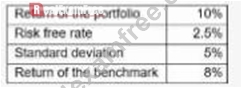
- A. 0.4
- B. 2.5
- C. 1.5
- D. 0
Answer: C
NEW QUESTION # 31
What is margin in an equity transaction?
- A. Good-faith deposit to ensure the client will make future financial obligations
- B. Amount paid by a client when he uses credit to buy securities
- C. Loan that a dealer extends to a client to buy securities.
- D. interest paid by the client to borrows securities.
Answer: C
Explanation:
In an equity transaction,marginrefers to the loan that a dealer extends to a client to facilitate the purchase of securities. The client pays a portion of the purchase price (the margin requirement), while the dealer provides the remainder as a loan. This enables clients to leverage their investments and potentially enhance returns, albeit with increased risk.
Other options:
* Amount paid by a client when using credit to buy securities: Describes the margin requirement but does not fully define margin.
* Good-faith deposit to ensure future financial obligations: Refers to initial margin in derivatives trading, not equity transactions.
* Interest paid by the client to borrow securities: Refers to short-selling, not buying on margin.
References:
* Volume 1, Chapter 9:Equity Transactions, section on "Margin Accounts" explains the mechanics of margin trading and loans.
NEW QUESTION # 32
Institutional clients tend to be more sophisticated than retail clients. What benefit does this translate into for CIRO dealer members?
- A. They are permitted to make trades on a discretionary basis for their clients.
- B. They are free of fiduciary obligations to their clients.
- C. They can organize their firms based specifically on client needs.
- D. They are subject to few, if any, investment restrictions.
Answer: C
NEW QUESTION # 33
For institutional trading, when does the investor need to provide trade-matching elements?
- A. With the initial order.
- B. After the dealer issues a trade execution notice.
- C. One the custodian confirms the trade.
- D. Once the trade clears.
Answer: B
Explanation:
Trade-matching is a critical process in institutional trading, ensuring that details of a trade (e.g., price, quantity, and settlement terms) align among the involved parties, including the investor, dealer, and custodian.
In Canada, institutional trade matching must occur within a specific timeline, and the investor is responsible for providing trade-matching elementsafter the trade execution notice is issued by the dealer.
Step-by-Step Explanation:
* What is Trade Matching?Trade matching involves the comparison of trade details between the buyer and seller (and their intermediaries) to confirm accuracy and reduce settlement risks.
* When Does the Investor Provide Trade-Matching Elements?
* After the dealer executes the trade, the dealer issues atrade execution noticeto the investor.
* The investor must then provide the necessary trade-matching details, such as account information, settlement instructions, and any other required confirmations.
* This process ensures that the trade can move seamlessly through to settlement.
* Why Not Other Options?
* Option B (Once the custodian confirms the trade):Incorrect. The custodian's role is typically involved in the final settlement process and not in providing trade-matching details.
* Option C (With the initial order):Incorrect. Trade-matching details are provided after the trade is executed, not at the time the order is placed.
* Option D (Once the trade clears):Incorrect. Trade matching occurs before the trade clears to ensure settlement.
References to Canadian Securities Course Exam 2 Study Materials:
* Volume 2, Chapter 27 - Institutional Clearing and Settlement
* Highlights the process of institutional trade matching, the roles of the investor, dealer, and custodian, and the required timelines.
* Volume 2, Chapter 27 - The Sell Side and the Buy Side of the Market
* Explains trade execution and the responsibilities of institutional clients and their intermediaries in completing trades.
Final answer:
* Option A (After the dealer issues a trade execution notice): Correct.
* Other options are incorrectbased on the standard processes for institutional trade matching in Canada.
NEW QUESTION # 34
A bond with a duration of five is currently priced at $103. If Interest rates rise by 2%. approximately what win be me bond's price?
- A. $108.15
- B. $92.70
- C. $97.85
- D. $113.30
Answer: C
Explanation:
The approximate price change of a bond due to a change in interest rates can be estimated using the formula:
Price Change (%)=#Duration×#Interest Rate\text{Price Change (\%)} = - \text{Duration} \times \Delta \text
{Interest Rate}Price Change (%)=#Duration×#Interest Rate
Given:
* Duration = 5
* Current Price = $103
* Change in Interest Rate (#\Delta#) = 2% or 0.02
Price Change (%)=#5×0.02=#0.10 (#10%)\text{Price Change (\%)} = -5 \times 0.02 = -0.10 \, (-10\%) Price Change (%)=#5×0.02=#0.10(#10%) The new price is calculated as:
New Price=Current Price×(1+Price Change)=103×(1#0.10)=103×0.90=97.85\text{New Price} = \text
{Current Price} \times (1 + \text{Price Change}) = 103 \times (1 - 0.10) = 103 \times 0.90 = 97.85 New Price=Current Price×(1+Price Change)=103×(1#0.10)=103×0.90=97.85
* A. $108.15 and B. $113.30: These represent price increases, which are incorrect for rising interest rates.
* D. $92.70: This reflects a greater-than-actual price drop, which is inconsistent with the duration-based calculation.
Reference:CSC Volume 1, Chapter 7, "Duration as a Measure of Bond Price Volatility" explains how bond prices respond to interest rate changes.
NEW QUESTION # 35
Tracy invests $12,000 in a five-year PPN linked to the S&P/TSX 60, with a participation rate of 75% and a performance cap of 27%. On the issue date of the PPN, the index level was 825, and at the PPN's maturity, the level was 1,200. How much will Tracy receive upon the PPN's maturity?
- A. $17,455
- B. $14,813
- C. $15,240
- D. $16,091
Answer: C
NEW QUESTION # 36
What information is an investor unable to retrieve through the SEDAR+ website?
- A. Interim financial statements.
- B. Annual information form.
- C. Annual report.
- D. Registration information for dealers.
Answer: D
NEW QUESTION # 37
Which regulatory body is responsible for the surveillance of trading and market-related activities of participants on Canadian equity marketplaces?
- A. CSA
- B. OBSI
- C. CIRO
- D. OSFI
Answer: C
Explanation:
TheCanadian Investment Regulatory Organization (CIRO)is responsible for overseeing trading and market-related activities of participants on Canadian equity marketplaces. CIRO conducts surveillance to ensure compliance with rules, regulations, and fair market practices.
Other options:
* OBSI (Ombudsman for Banking Services and Investments): Handles disputes between financial institutions and their clients but does not conduct trading surveillance.
* OSFI (Office of the Superintendent of Financial Institutions): Regulates and supervises federally regulated financial institutions, focusing on their solvency.
* CSA (Canadian Securities Administrators): Coordinates securities regulation across Canada but does not directly monitor trading activities.
References:
* Volume 1, Chapter 3:The Canadian Regulatory Environment, section on "Market Surveillance and Trading Oversight" explains CIRO's role.
NEW QUESTION # 38
......
Feel CSI CSC2 Dumps PDF Will likely be The best Option: https://examsboost.realexamfree.com/CSC2-real-exam-dumps.html
