

Databricks-Certified-Data-Engineer-Associate Practice Exams and Training Solutions for Certifications
Dumps Free Test Engine Player Verified Answers
NEW QUESTION # 77
A data engineer is maintaining a data pipeline. Upon data ingestion, the data engineer notices that the source data is starting to have a lower level of quality. The data engineer would like to automate the process of monitoring the quality level.
Which of the following tools can the data engineer use to solve this problem?
- A. Delta Lake
- B. Unity Catalog
- C. Delta Live Tables
- D. Data Explorer
- E. Auto Loader
Answer: C
Explanation:
Explanation
https://docs.databricks.com/delta-live-tables/expectations.html
Delta Live Tables is a tool provided by Databricks that can help data engineers automate the monitoring of data quality. It is designed for managing data pipelines, monitoring data quality, and automating workflows.
With Delta Live Tables, you can set up data quality checks and alerts to detect issues and anomalies in your data as it is ingested and processed in real-time. It provides a way to ensure that the data quality meets your desired standards and can trigger actions or notifications when issues are detected. While the other tools mentioned may have their own purposes in a data engineeringenvironment, Delta Live Tables is specifically designed for data quality monitoring and automation within the Databricks ecosystem.
NEW QUESTION # 78
A data engineer needs to apply custom logic to identify employees with more than 5 years of experience in array column employees in table stores. The custom logic should create a new column exp_employees that is an array of all of the employees with more than 5 years of experience for each row. In order to apply this custom logic at scale, the data engineer wants to use the FILTER higher-order function.
Which of the following code blocks successfully completes this task?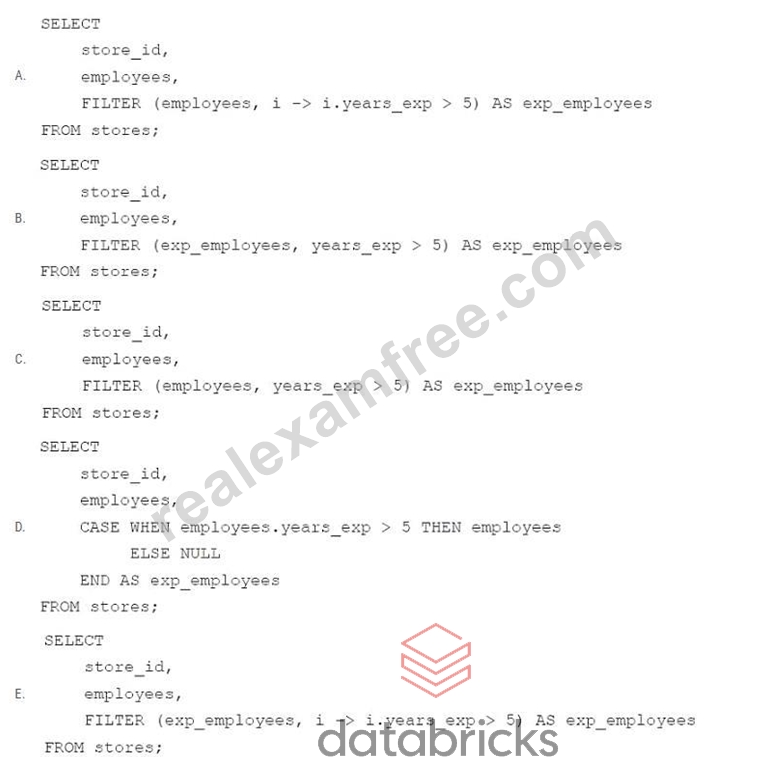
- A. Option E
- B. Option D
- C. Option B
- D. Option C
- E. Option A
Answer: E
Explanation:
Option A is the correct answer because it uses the FILTER higher-order function correctly to filter out employees with more than 5 years of experience from the array column "employees". It applies a lambda function i -> i.years_exp > 5 that checks if the years of experience of each employee in the array is greater than 5. If this condition is met, the employee is included in the new array column "exp_employees".
The use of higher-order functions like FILTER can be referenced from Databricks documentation on Higher- Order Functions.
NEW QUESTION # 79
Which of the following describes the type of workloads that are always compatible with Auto Loader?
- A. Dashboard workloads
- B. Streaming workloads
- C. Machine learning workloads
- D. Serverless workloads
- E. Batch workloads
Answer: B
Explanation:
Explanation
Auto Loader is a feature of Databricks that simplifies and automates the process of loading streaming data into Delta Lake tables. Auto Loader can detect new and updated files in cloud storage and efficiently load them as micro-batches or as a continuous stream. Auto Loader is always compatible with streaming workloads, as it is designed to handle streaming sources such as Amazon S3, Azure Data Lake Storage Gen2, and Azure Blob Storage. The other types of workloads may or may not be compatible with Auto Loader, depending on the data source and the use case. References: The information can be referenced from Databricks documentation on Auto Loader: Auto Loader.
https://community.databricks.com/t5/data-engineering/practice-exams-for-databricks-certified-data-engineer/td-p
NEW QUESTION # 80
Which file format is used for storing Delta Lake Table?
- A. SV
- B. Delta
- C. Parquet
- D. JSON
Answer: C
NEW QUESTION # 81
A new data engineering team has been assigned to work on a project. The team will need access to database customers in order to see what tables already exist. The team has its own group team.
Which of the following commands can be used to grant the necessary permission on the entire database to the new team?
- A. GRANT USAGE ON CATALOG team TO customers;
- B. GRANT CREATE ON DATABASE team TO customers;
- C. GRANT VIEW ON CATALOG customers TO team;
- D. GRANT USAGE ON DATABASE customers TO team;
- E. GRANT CREATE ON DATABASE customers TO team;
Answer: D
Explanation:
1: The correct command to grant the necessary permission on the entire database to the new team is to use the GRANT USAGE command. The GRANT USAGE command grants the principal the ability to access the securable object, such as a database, schema, or table. In this case, the securable object is the database customers, and the principal is the group team. By granting usage on the database, the team will be able to see what tables already exist in the database. Option E is the only option that uses the correct syntax and the correct privilege type for this scenario. Option A uses the wrong privilege type (VIEW) and the wrong securable object (CATALOG). Option B uses the wrong privilege type (CREATE), which would allow the team to create new tables in the database, but not necessarily see the existing ones. Option C uses the wrong securable object (CATALOG) and the wrong principal (customers). Option D uses the wrong securable object (team) and the wrong principal (customers). Reference: GRANT, Privilege types, Securable objects, Principals
NEW QUESTION # 82
A data engineer needs to create a table in Databricks using data from their organization's existing SQLite database.
They run the following command: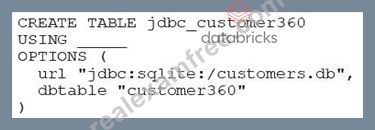
Which of the following lines of code fills in the above blank to successfully complete the task?
- A. sqlite
- B. autoloader
- C. org.apache.spark.sql.sqlite
- D. org.apache.spark.sql.jdbc
- E. DELTA
Answer: A
Explanation:
In the given command, a data engineer is trying to create a table in Databricks using data from an SQLite database. The correct option to fill in the blank is "sqlite" because it specifies the type of database being connected to in a JDBC connection string. The USING clause should be followed by the format of the data, and since we are connecting to an SQLite database, "sqlite" would be appropriate here. References:
Create a table using JDBC
JDBC connection string
SQLite JDBC driver
NEW QUESTION # 83
A data engineer has a Python variable table_name that they would like to use in a SQL query. They want to construct a Python code block that will run the query using table_name.
They have the following incomplete code block:
____(f"SELECT customer_id, spend FROM {table_name}")
Which of the following can be used to fill in the blank to successfully complete the task?
- A. spark.sql
- B. dbutils.sql
- C. spark.delta.sql
- D. spark.table
- E. spark.delta.table
Answer: A
Explanation:
The spark.sql method can be used to execute SQL queries programmatically and return the result as a DataFrame. The spark.sql method accepts a string argument that contains a valid SQL statement. The data engineer can use a formatted string literal (f-string) to insert the Python variable table_name into the SQL query. The other methods are either invalid or not suitable for running SQL queries. References: Running SQL Queries Programmatically, Formatted string literals, spark.sql
NEW QUESTION # 84
Which of the following statements regarding the relationship between Silver tables and Bronze tables is always true?
- A. Silver tables contain a less refined, less clean view of data than Bronze data.
- B. Silver tables contain aggregates while Bronze data is unaggregated.
- C. Silver tables contain a more refined and cleaner view of data than Bronze tables.
- D. Silver tables contain more data than Bronze tables.
- E. Silver tables contain less data than Bronze tables.
Answer: D
Explanation:
Explanation
https://www.databricks.com/glossary/medallion-architecture
NEW QUESTION # 85
A data engineer wants to schedule their Databricks SQL dashboard to refresh once per day, but they only want the associated SQL endpoint to be running when it is necessary.
Which of the following approaches can the data engineer use to minimize the total running time of the SQL endpoint used in the refresh schedule of their dashboard?
- A. They can turn on the Auto Stop feature for the SQL endpoint.
- B. They can ensure the dashboard's SQL endpoint is not one of the included query's SQL endpoint.
- C. They can set up the dashboard's SQL endpoint to be serverless.
- D. They can reduce the cluster size of the SQL endpoint.
- E. They can ensure the dashboard's SQL endpoint matches each of the queries' SQL endpoints.
Answer: C
Explanation:
A serverless SQL endpoint is a compute resource that is automatically managed by Databricks and scales up or down based on the workload. A serverless SQL endpoint can be used to run queries and dashboards without requiring manual configuration or management. A serverless SQL endpoint is only active when it is needed and shuts down automatically when idle, minimizing the total running time and cost. A serverless SQL endpoint can be created and assigned to a dashboard using the Databricks SQL UI or the SQL Analytics API. Reference:
Create a serverless SQL endpoint
Assign a SQL endpoint to a dashboard
SQL Analytics API
NEW QUESTION # 86
A dataset has been defined using Delta Live Tables and includes an expectations clause:
CONSTRAINT valid_timestamp EXPECT (timestamp > '2020-01-01') ON VIOLATION FAIL UPDATE What is the expected behavior when a batch of data containing data that violates these constraints is processed?
- A. Records that violate the expectation are added to the target dataset and recorded as invalid in the event log.
- B. Records that violate the expectation cause the job to fail.
- C. Records that violate the expectation are dropped from the target dataset and recorded as invalid in the event log.
- D. Records that violate the expectation are added to the target dataset and flagged as invalid in a field added to the target dataset.
Answer: C
Explanation:
The expected behavior when a batch of data containing data that violates the expectation is processed is that the job will fail. This is because the expectation clause has the ON VIOLATION FAIL UPDATE option, which means that if any record in the batch does not meet the expectation, the entire batch will be rejected and the job will fail. This option is useful for enforcing strict data quality rules and preventing invalid data from entering the target dataset.
Option A is not correct, as the ON VIOLATION FAIL UPDATE option does not drop the records that violate the expectation, but fails the entire batch. To drop the records that violate the expectation and record them as invalid in the event log, the ON VIOLATION DROP RECORD option should be used.
Option C is not correct, as the ON VIOLATION FAIL UPDATE option does not drop the records that violate the expectation, but fails the entire batch. To drop the records that violate the expectation and load them into a quarantine table, the ON VIOLATION QUARANTINE RECORD option should be used.
Option D is not correct, as the ON VIOLATION FAIL UPDATE option does not add the records that violate the expectation, but fails the entire batch. To add the records that violate the expectation and record them as invalid in the event log, the ON VIOLATION LOG RECORD option should be used.
Option E is not correct, as the ON VIOLATION FAIL UPDATE option does not add the records that violate the expectation, but fails the entire batch. To add the records that violate the expectation and flag them as invalid in a field added to the target dataset, the ON VIOLATION FLAG RECORD option should be used.
:
Delta Live Tables Expectations
[Databricks Data Engineer Professional Exam Guide]
NEW QUESTION # 87
A single Job runs two notebooks as two separate tasks. A data engineer has noticed that one of the notebooks is running slowly in the Job's current run. The data engineer asks a tech lead for help in identifying why this might be the case.
Which of the following approaches can the tech lead use to identify why the notebook is running slowly as part of the Job?
- A. They can navigate to the Tasks tab in the Jobs UI and click on the active run to review the processing notebook.
- B. There is no way to determine why a Job task is running slowly.
- C. They can navigate to the Runs tab in the Jobs UI to immediately review the processing notebook.
- D. They can navigate to the Runs tab in the Jobs UI and click on the active run to review the processing notebook.
- E. They can navigate to the Tasks tab in the Jobs UI to immediately review the processing notebook.
Answer: A
Explanation:
The Tasks tab in the Jobs UI shows the list of tasks that are part of a job, and allows the user to view the details of each task, such as the notebook path, the cluster configuration, the run status, and the duration. By clicking on the active run of a task, the user can access the Spark UI, the notebook output, and the logs of the task. These can help the user to identify the performance bottlenecks and errors in the task. The Runs tab in the Jobs UI only shows the summary of the job runs, such as the start time, the end time, the trigger, and the status. It does not provide the details of the individual tasks within a job run. Reference: Jobs UI, Monitor running jobs with a Job Run dashboard, How to optimize jobs performance
NEW QUESTION # 88
Which of the following benefits is provided by the array functions from Spark SQL?
- A. An ability to work with time-related data in specified intervals
- B. An ability to work with complex, nested data ingested from JSON files
- C. An ability to work with an array of tables for procedural automation
- D. An ability to work with data within certain partitions and windows
- E. An ability to work with data in a variety of types at once
Answer: B
Explanation:
The array functions from Spark SQL are a subset of the collection functions that operate on array columns1. They provide an ability to work with complex, nested data ingested from JSON files or other sources2. For example, the explode function can be used to transform an array column into multiple rows, one for each element in the array3. The array_contains function can be used to check if a value is present in an array column4. The array_join function can be used to concatenate all elements of an array column with a delimiter. These functions can be useful for processing JSON data that may have nested arrays or objects. References: 1: Spark SQL, Built-in Functions - Apache Spark 2: Spark SQL Array Functions Complete List - Spark By Examples 3: Spark SQL Array Functions - Syntax and Examples - DWgeek.
com 4: Spark SQL, Built-in Functions - Apache Spark : Spark SQL, Built-in Functions - Apache Spark :
[Working with Nested Data Using Higher Order Functions in SQL on Databricks - The Databricks Blog]
NEW QUESTION # 89
Which of the following describes the storage organization of a Delta table?
- A. Delta tables are stored in a collection of files that contain data, history, metadata, and other attributes.
- B. Delta tables store their data in a single file and all metadata in a collection of files in a separate location.
- C. Delta tables are stored in a collection of files that contain only the data stored within the table.
- D. Delta tables are stored in a single file that contains data, history, metadata, and other attributes.
- E. Delta tables are stored in a single file that contains only the data stored within the table.
Answer: A
NEW QUESTION # 90
A data engineer at a company that uses Databricks with Unity Catalog needs to share a collection of tables with an external partner who also uses a Databricks workspace enabled for Unity Catalog. The data engineer decides to use Delta Sharing to accomplish this.
What is the first piece of information the data engineer should request from the external partner to set up Delta Sharing?
- A. The sharing identifier of their Unity Catalog metastore
- B. Their Databricks account password
- C. The name of their Databricks cluster
- D. The IP address of their Databricks workspace
Answer: A
NEW QUESTION # 91
A data engineer runs a statement every day to copy the previous day's sales into the table transactions. Each day's sales are in their own file in the location "/transactions/raw".
Today, the data engineer runs the following command to complete this task: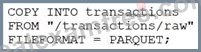
After running the command today, the data engineer notices that the number of records in table transactions has not changed.
Which of the following describes why the statement might not have copied any new records into the table?
- A. The format of the files to be copied were not included with the FORMAT_OPTIONS keyword.
- B. The names of the files to be copied were not included with the FILES keyword.
- C. The previous day's file has already been copied into the table.
- D. The COPY INTO statement requires the table to be refreshed to view the copied rows.
- E. The PARQUET file format does not support COPY INTO.
Answer: C
Explanation:
The COPY INTO statement is an idempotent operation, which means that it will skip any files that have already been loaded into the target table1. This ensures that the data is not duplicated or corrupted by multiple attempts to load the same file. Therefore, if the data engineer runs the same command every day without specifying the names of the files to be copied with the FILES keyword or a glob pattern with the PATTERN keyword, the statement will only copy the first file that matches the source location and ignore the rest. To avoid this problem, the data engineer should either use the FILES or PATTERN keywords to filter the files to be copied based on the date or some other criteria, or delete the files from the source location after they are copied into the table2. References: 1: COPY INTO | Databricks on AWS 2: Get started using COPY INTO to load data | Databricks on AWS
NEW QUESTION # 92
......
The GAQM Databricks-Certified-Data-Engineer-Associate (Databricks Certified Data Engineer Associate) Exam is a comprehensive certification program designed to validate the skills and knowledge of data engineers in using Databricks to build and manage data pipelines, perform data analysis, and develop data-driven solutions. Databricks-Certified-Data-Engineer-Associate exam is designed for professionals who work with big data and are responsible for designing, building, and maintaining data pipelines using Databricks.
Q&As with Explanations Verified & Correct Answers: https://examsboost.realexamfree.com/Databricks-Certified-Data-Engineer-Associate-real-exam-dumps.html
