

[Jul 02, 2026] Valid C_THR87_2505 Test Answers Full-length Practice Certification Exams
Accurate & Verified 2026 New C_THR87_2505 Answers As Experienced in the Actual Test!
SAP C_THR87_2505 Exam Syllabus Topics:
| Topic | Details |
|---|---|
| Topic 1 |
|
| Topic 2 |
|
| Topic 3 |
|
| Topic 4 |
|
| Topic 5 |
|
| Topic 6 |
|
| Topic 7 |
|
| Topic 8 |
|
NEW QUESTION # 46
Your client wants to award quarterly bonuses, where the quarters are aligned as follows: Q1: November 1-January 31. Q2: February 1-April 30. Q3: May 1-July 31. Q4: August 1-October 31. Bonuses are paid at the end of each quarter. Which of the following combinations of configuration options would work for this scenario?
- A. One variable pay template with the bonus start date November 1 and end date October 31; employee history is loaded with four records per employee (one per quarter) and bonus paid in full on October 31
- B. Four variable pay templates, with the bonus start and end dates aligned with the customer's dates and employee history to match
- C. One variable pay template with the bonus start date November 1 and end date October 31, and the bonus plan multiplier set to 25%
- D. Four variable pay templates, with the bonus start and end dates aligned with "traditional" quarter dates and custom columns in the employee history to display the customer's dates
Answer: C,D
NEW QUESTION # 47
What attribute must you change when creating a new Business Goal XML template to ensure that the correct business goals are referenced?
- A. Plan ID
- B. Plan number format
- C. Plan name
- D. Plan type
Answer: A,C,D
NEW QUESTION # 48
Where do you set the display order of the business goals?
- A. Business goals file
- B. Business goal weights file
- C. Design Worksheet
- D. Bonus plan file
Answer: B
NEW QUESTION # 49
You want to see historical payouts initiated through manager self-service from the Variable Pay form. What do you use?
- A. Compensation profile
- B. Executive review
- C. Custom views
- D. Field-based permission
Answer: A
NEW QUESTION # 50
Your customer wants to use its business units to assign goal achievements. What are the first steps to set up this requirement? Note: There are 2 correct answers to this question.
- A. Import business unit data via the user data file.
- B. Define the Business Unit field in the Variable Pay Background Element XML.
- C. Import business unit data via the employee history data file.
- D. Define the Business Unit field as a department in the Succession Data Model XML.
Answer: B,C
NEW QUESTION # 51
Your client wants to change the label on a field in the Assignment Details level of their worksheet. Where could you make the change? Note: There are 2 correct answers to this question.
- A. Column Designer, Entry Level fields
- B. Custom Views
- C. Employee History background element
- D. Column Designer, Assignment Level fields
Answer: C,D
NEW QUESTION # 52
The bonuses of all employees at your client are determined by the following results: 30% Corporate Performance. 30% Country Performance. 40% Individual Achievement. All employees have the same result for Corporate Performance, but the result for Country Performance varies based on the employee's country. The Individual Achievement comes from a linked performance form's overall result. How would this be configured? Note: There are 2 correct answers to this question.
- A. Additive plan with two Business Goal sections. Corporate Performance in one Business Goal section, weighted at 30%. Country Performance in other section, weighted at 30%. Individual section weighted at 40%
- B. Additive plan with one Business Goal section. The Business Goal section is weighted 30% and the Individual section is weighted 40%. Within the Business Goal section, Corporate Performance is weighted 30% and Country Performance is weighted 30%
- C. Additive plan with one Business Goal section. The Business Goal section is weighted 60% and the Individual section is weighted 40%. Within the Business Goal section, Corporate Performance is weighted 30% and Country Performance is weighted 30%
- D. Additive plan with one Business Goal section. The Business Goal section is weighted 60% and the Individual section is weighted 40%. Within the Business Goal section, Corporate Performance is weighted 50% and Country Performance is weighted 50%
Answer: A,D
NEW QUESTION # 53
A customer is using a custom formula to calculate the employee basis. What must you do to ensure that the basis calculates correctly?
- A. Configure the Basis field as a custom field in the background element.
- B. Delete the Basis field header when importing the employee history data file.
- C. Leave the Basis field blank when importing the employee history data file.
- D. Configure the Basis field to be hidden in the background element.
Answer: D
NEW QUESTION # 54
Your customer is using a hybrid variable pay template because Employee Central (EC) has NOT been implemented within the entire company. How will you make sure that eligibility rules apply to both (EC and non-EC) target populations? Note: There are 3 correct answers to this question.
- A. Use Manager Form Eligibility.
- B. Use Bonus Plan Eligibility.
- C. Configure multiple rules by EC entity for the program.
- D. Enable global eligibility rule.
- E. Include inactive employees.
Answer: C
NEW QUESTION # 55
How is goal payout determined when using the direct payout function type?
- A. Direct payout percentage will override normal performance payout calculation.
- B. The higher amount between the direct payout percentage and the performance maximum payout percentage will be used.
- C. The lower amount between the direct payout percentage and the estimated target payout calculation will be used.
- D. The lower amount between the direct payout percentage and the performance minimum payout percentage will be used.
Answer: A
NEW QUESTION # 56
A performance management (PM) form will be considered a match to an assignment when its period overlaps with the period of the assignment. Which combination of conditions qualifies as "overlap"?
- A. PM form start date <= Assignment start date. PM form end date <= Assignment end date
- B. PM form start date <= Assignment end date. Assignment start date <= PM form end date
- C. PM form start date <= Assignment start date. Assignment start date >= PM form end date
- D. PM form start date >= Assignment end date. Assignment start date <= PM form start date
Answer: B
NEW QUESTION # 57
Your customer wants to display historical bonus payments with the current worksheet. How can they show this information? Note: There are 2 correct answers to this question.
- A. Configure custom views in plan setup.
- B. Build an integration with the previous variable pay goal template.
- C. Define compensation period data in the compensation profile.
- D. Create eligibility rules to pull historical data from previous plans.
Answer: A,C
NEW QUESTION # 58
Your customer wants to load the final results of business goals to be used in payout calculation. What column from the business goal import file must be used to load the results of each business goal?
- A. notes
- B. payoutFunctionType
- C. directPayout
- D. payoutPercentTarget
Answer: D
NEW QUESTION # 59
The screenshot below is the entire currency conversion table. The functional currency of this customer is USD. Which currency view modes can be used with this table?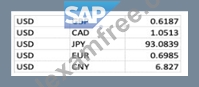
- A. Functional, User, Planner, and Any Currency
- B. Functional only
- C. Functional, User, and Planner
- D. Functional and User
Answer: D
NEW QUESTION # 60
From where can you pull fields to assign business goals to employees through the business goals import file?
- A. Summary level custom reportable fields
- B. Employee history fields
- C. Bonus plan weights
- D. Summary level standard fields
Answer: B
NEW QUESTION # 61
Company XYZ rewards its sales employees based on company and individual performance. Each employee's target bonus is a percentage of their salary. Both company and individual performance are combined, then multiplied by the basis. Employees are assigned weighted goals under company performance (revenue, profit, etc.). Which of the following bonus calculation equations is best to use for this organization?
- A. base + (business performance + individual performance)
- B. base x (business performance x individual performance)
- C. base x business performance x individual performance
- D. base x (business performance + individual performance)
Answer: D
NEW QUESTION # 62
Where do you define the payout function type?
- A. Background Element
- B. Business Goals
- C. Bonus Plan
- D. Business Goal Weights
Answer: B
NEW QUESTION # 63
Which of the following data files are linked by legacy eligibility rules? Note: There are 2 correct answers to this question.
- A. Business goals data file
- B. Bonus plan data file
- C. Employee history data file
- D. User data file
Answer: B,C
NEW QUESTION # 64
......
Certification Topics of C_THR87_2505 Exam PDF Recently Updated Questions: https://examsboost.realexamfree.com/C_THR87_2505-real-exam-dumps.html
