

Online H12-841_V1.5 Test Brain Dump Question and Test Engine
Real Huawei H12-841_V1.5 Exam Dumps with Correct 316 Questions and Answers
NEW QUESTION # 34
In Huawei's WAN bandwidth management solution, which of the following functions can "limit the bandwidth usage of non-critical services such as P2P downloads and ensure the bandwidth of core services (such as ERP)"?
- A. Application-based bandwidth limiting policies (P2P services are limited, core services are guaranteed bandwidth)
- B. All services are allocated the same bandwidth, without any priority distinction.
- C. Allocate bandwidth quotas for core services, without limiting them to non-critical services.
- D. Shut down non-critical services and only allow core services to access the network.
Answer: A
NEW QUESTION # 35
In Huawei's WAN solution, for "collaborative office files (such as shared documents) transmitted across regions," which of the following technologies can "reduce file synchronization latency and improve collaboration efficiency"?
- A. Reduce the frequency and number of file synchronizations.
- B. File difference synchronization technology (only synchronizes modified file segments, does not transfer the entire file)
- C. Only increase link bandwidth without optimizing the synchronization mechanism.
- D. Directly synchronize the entire file without performing differential synchronization.
Answer: B
NEW QUESTION # 36
In Huawei's SD-WAN solution, which of the following technologies can "enable direct access between branch devices and public clouds (such as AWS), bypassing headquarters relay and reducing latency"?
- A. All cloud access traffic is relayed through headquarters before accessing cloud resources.
- B. Manually configure static routes to point to the cloud network segment, without dynamic adaptation.
- C. Accessing cloud resources solely via internet connection, without any optimization measures.
- D. Deploy SD-WAN cloud access points ( PoP ) for direct connection to the public cloud.
Answer: D
NEW QUESTION # 37
In troubleshooting MPLS VPN networks, if "the CE device can ping the local PE device, but cannot ping the remote PE device", which of the following troubleshooting steps should be performed first?
- A. Check if the MPLS protocol is enabled on the P device.
- B. Check if an MPLS LSP has been established between the local PE device and the remote PE device.
- C. Check if the static routes of the CE device are configured correctly.
- D. Check if the VPN instance has been created on the remote PE device.
Answer: B
NEW QUESTION # 38
In Huawei's WAN solution, for "remote desktop (RDP/VDI) traffic transmitted across regions", which of the following technologies can "reduce screen stuttering and improve the smoothness of remote operation"?
- A. Lower the remote desktop resolution, sacrificing image quality for smoother performance.
- B. Only increase link bandwidth without optimizing the transmission mechanism.
- C. Remote desktop traffic QoS priority scheduling (set high priority) + screen compression optimization
- D. Directly transmit remote desktop traffic without optimization.
Answer: C
NEW QUESTION # 39
(On a VXLAN-based virtualized campus network, terminals communicate with each other through VXLAN tunnels. When the campus network needs to communicate with external networks, the data must pass through border nodes.)
- A. FALSE
- B. TRUE
Answer: B
Explanation:
Comprehensive and Detailed Explanation (200-250 words):
In a VXLAN-based virtualized campus network, user terminals located in different access locations communicate with each other overVXLAN tunnelsestablished between VXLAN Tunnel Endpoints (VTEPs).
These VXLAN tunnels form the overlay network, which abstracts the physical underlay and enables flexible Layer 2 and Layer 3 connectivity across the campus.
When communication is confined within the virtualized campus network, traffic remains inside the VXLAN overlay and is encapsulated and forwarded between VTEPs. However, when users or services inside the VXLAN network need to accessexternal networks, such as traditional IP networks, the Internet, or data centers that do not support VXLAN, traffic must exit the VXLAN overlay. This function is performed by border nodes.
Border nodes act as the boundary between the VXLAN overlay and non-VXLAN networks. They are responsible for VXLAN encapsulation and decapsulation, routing between VXLAN segments and external networks, and enforcing security and policy controls at the network edge. According to HCIP Datacom Campus Network architecture principles, all traffic entering or leaving the VXLAN-based campus must pass through border nodes to ensure proper routing, policy enforcement, and service control.
Therefore, the statement is TRUE, and option A is correct.
NEW QUESTION # 40
In MPLS VPN network troubleshooting, if it is necessary to "view the ARP table of the VPN instance on the PE device to confirm whether the CE device's MAC address is being learned normally", which of the following commands should be used?
- A. display bgp vpnv4 all routes
- B. Display IP routing-table VPN instance [instance name]
- C. display mpls lsp
- D. display arp VPN instance [instance name]
Answer: D
NEW QUESTION # 41
In the Huawei SD-WAN iMaster NCE-WAN management platform, which of the following functions can " perform compliance checks on the configuration of branch devices to prevent unauthorized configurations (such as failure to configure ACL protection)"?
- A. Network topology visualization
- B. Configure compliance checks and violation alerts
- C. Equipment hardware resource monitoring
- D. Batch distribution of configuration templates
Answer: B
NEW QUESTION # 42
Which of the following is NOT a core function of the Huawei SD-WAN iMaster NCE-WAN management platform?
- A. Only manual device configuration via command line is supported.
- B. Batch distribution of branch device configuration templates
- C. Automatic network topology discovery and visualization
- D. Real-time monitoring and alerting of network performance
Answer: A
NEW QUESTION # 43
In the OSPF protocol for wide area networks, which of the following is the generator of a Type 2 LSA (Network LSA)?
- A. All routers within the area
- B. DR (Designated Router) within the area
- C. Autonomous System Border Router (ASBR)
- D. Area Border Router (ABR)
Answer: B
NEW QUESTION # 44
In a WAN BGP protocol deployment, if it is necessary to "remove a specific AS number from the AS PATH attribute of an EBGP neighbor when receiving routes", which of the following policies should be configured?
- A. Apply a prefix list to the outbound direction of BGP neighbors to restrict route advertising.
- B. Apply as-path-filter to the inbound direction of BGP neighbors to filter specific AS numbers.
- C. Configure BGP neighbor MD5 authentication
- D. Enable BGP route aggregation to merge routes containing specific ASs.
Answer: B
NEW QUESTION # 45
In a wide area network (WAN) IPv6 transition scenario, if "internal IPv6 terminals need to access internal servers that only support IPv4", which of the following technologies should be used?
- A. DNS64 (only performs domain name resolution, does not perform address translation)
- B. NAT64 (translates IPv6 addresses into IPv4 addresses to enable access)
- C. IPv4/IPv6 dual-stack technology (server must support IPv6)
- D. IPv6 over IPv4 tunnel (only enables communication between IPv6 terminals)
Answer: B
NEW QUESTION # 46
In an MPLS VPN network, which of the following descriptions best fits the role of a "CE device"?
- A. Connect to the operator's backbone network and participate in MPLS label forwarding.
- B. Belongs to the customer's network equipment, directly connected to the PE device, and does not participate in MPLS protocol processing.
- C. Responsible for VPN routing between PE devices.
- D. Maintain VPN instances and dual-label forwarding mechanism
Answer: B
NEW QUESTION # 47
In the WAN BGP protocol, which of the following attributes can be used to "transmit route priority to IBGP neighbors, with a larger value indicating higher priority"?
- A. Next Hop
- B. MED
- C. Local Preference
- D. AS_PATH
Answer: C
NEW QUESTION # 48
In the OSPF protocol for wide area networks, what is the function of Type 7 LSA (NSSA External LSA)?
- A. Transmit external AS routes throughout the entire OSPF Autonomous System without translation.
- B. When transmitting external routes from an AS within an NSSA area, the ABR must convert them to Type 5 LSA before transmitting them to other areas.
- C. Transfer summarized routes between areas to reduce routing table entries.
- D. Transmit link-state information between routers within the area.
Answer: B
NEW QUESTION # 49
(VXLAN identifies tenants using VNIs, which are 24 bits long. A tenant can have one or more VNIs, and VXLAN supports a maximum of 12 million tenants.)
- A. FALSE
- B. TRUE
Answer: A
Explanation:
VXLAN uses theVXLAN Network Identifier (VNI)to identify and isolate virtual Layer 2 or Layer 3 networks in an overlay environment. The VNI field is24 bits long, which allows a theoretical maximum of2²# (approximately 16 million) VNIs. This is a significant improvement over traditional VLAN technology, which supports only 4094 VLAN IDs, and is one of the main reasons VXLAN is adopted in large-scale campus and data center networks.
It is correct thata tenant can be mapped to one or more VNIs. For example, a tenant may use multiple VNIs to represent different broadcast domains or service segments, such as separate VNIs for different subnets or application tiers. However, the statement becomes incorrect when it claims that VXLAN supports a maximum of12 million tenants.
VXLAN does not directly define a fixed maximum number of tenants. VNIs represent virtual networks, not tenants themselves. The actual number of tenants supported depends on how VNIs are allocated and how the network design maps tenants to VNIs. In theory, the upper limit of VNIs is close to 16 million, not 12 million, and the number of tenants is typically much lower and design-dependent.
Therefore, while the description of VNIs being 24 bits long is correct, the conclusion about supporting a maximum of 12 million tenants is incorrect, making the overall statement false.
NEW QUESTION # 50
In Huawei's WAN solution, which of the following technologies can optimize the transmission experience of "cross-regional video conferencing" and reduce lag and latency? (Multiple choice)
- A. Fixed video bitrate, not adjusted according to link status .
- B. No traffic priority; video and regular data compete for bandwidth.
- C. Edge node caching (caching video streams locally to reduce long-distance transmission latency)
- D. Video traffic priority scheduling (based on DSCP tag priority forwarding of video data packets)
- E. Dynamic bandwidth adjustment (adjusting video bitrate based on link load)
Answer: C,D,E
NEW QUESTION # 51
In Huawei's SD-WAN solution, for the scenario of " branch multi-link (MPLS + Internet + 5G) load balancing", which of the following technologies can "dynamically adjust the traffic allocation ratio according to the real-time bandwidth utilization of the link"?
- A. All traffic is prioritized to use the MPLS link; other links are only used as cold backups.
- B. Dynamic load balancing based on link bandwidth utilization (reducing traffic on links with high utilization and increasing traffic on links with low utilization).
- C. Randomly allocate traffic to each link, without considering bandwidth utilization.
- D. Allocate traffic according to a fixed ratio (e.g., 40% MPLS, 30% Internet, 30% 5G), without adjusting for bandwidth changes.
Answer: B
NEW QUESTION # 52
(As shown in the following figure, R1 and R2 establish an IPsec VPN in ISAKMP mode for communication.
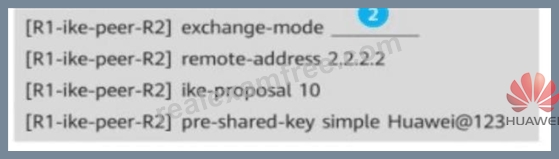
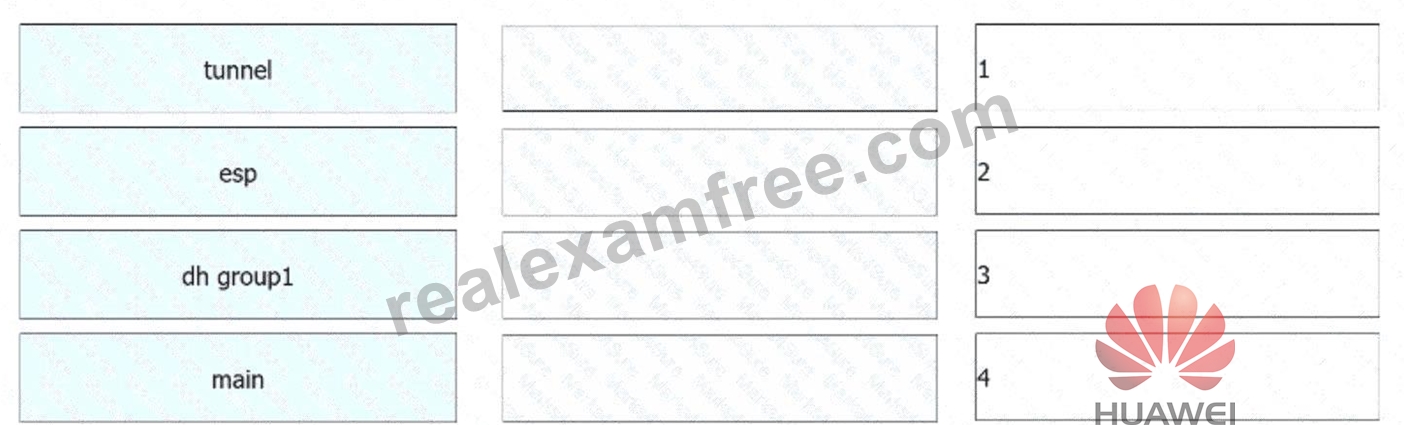
For IPsec proposals on R1 and R2, ESP is used, the encapsulation mode is set to tunnel mode, SHA1 is configured as the authentication algorithm, and AES-256 is configured as the encryption algorithm. In addition, IKEv1 is configured for IKE peers, the main mode is configured for IKEv1 negotiation phase 1, and the PSK Huawei@123 is configured for PSK authentication between IKE peers. For IKE proposals on R1 and R2, SHA1 is configured as the authentication algorithm, AES-256 is configured as the encryption algorithm, and DH group 1 is configured for IKE negotiation. Based on these configurations on R1 and R2, drag the configuration items on the left to the correct locations on the right.)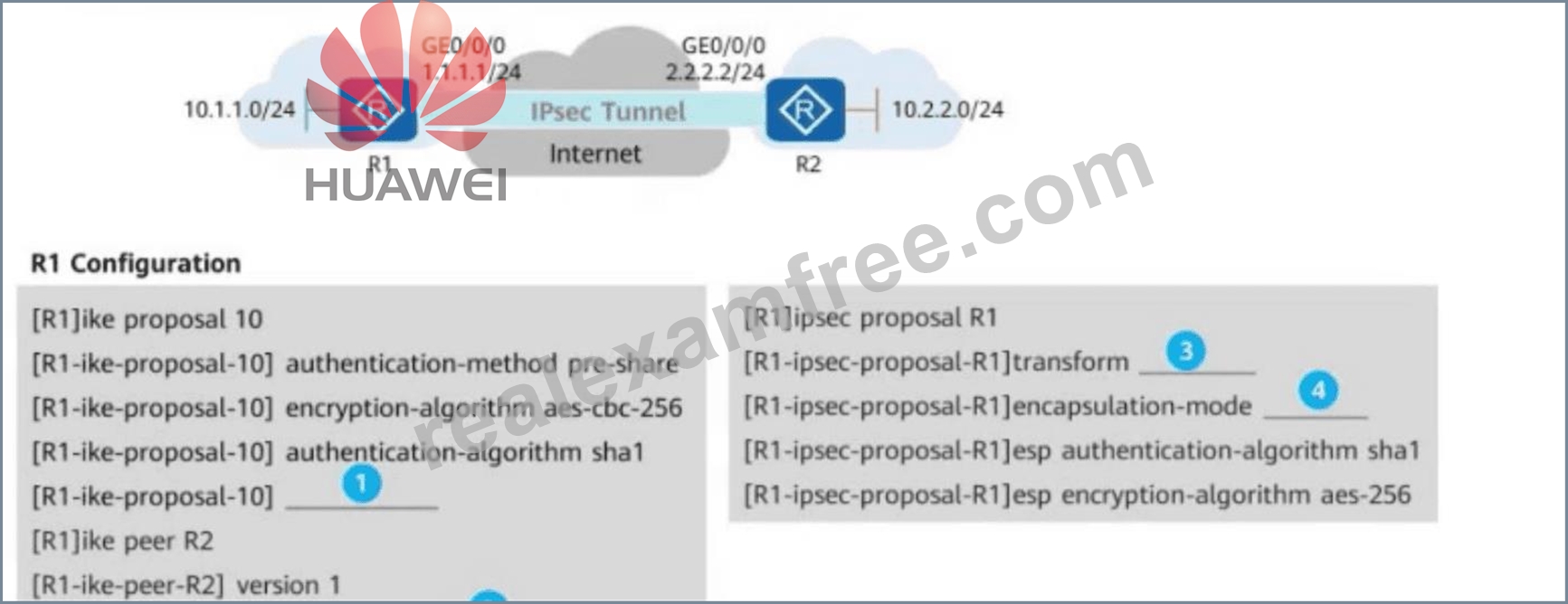
Answer:
Explanation: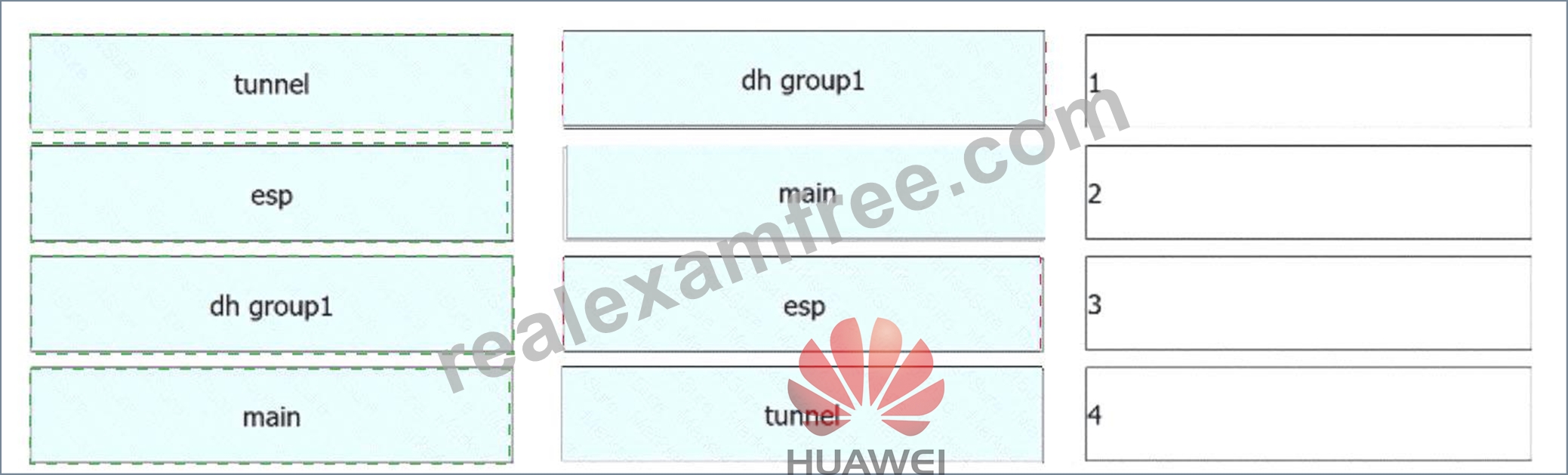
Explanation:
1 #dh group1
2 #main
3 #esp
4 #tunnel
In the IKE proposal, the Diffie-Hellman group defines the key exchange strength used during IKE Phase 1 negotiation, which is whydh group1corresponds to position 1 under the IKE proposal configuration. The exchange-mode mainsetting is part of IKEv1 Phase 1 and therefore correctly matches position 2 under the IKE peer configuration.
For the IPsec proposal, thetransformspecifies the protocol used to protect data traffic; since ESP is explicitly required,espcorrectly maps to position 3. Finally, theencapsulation-mode tunneldefines how packets are encapsulated in IPsec VPNs between gateways, makingtunnelthe correct match for position 4.
This mapping strictly follows HCIP Datacom Campus Network IPsec and IKE configuration logic and aligns with standard Huawei VRP command behavior.
NEW QUESTION # 53
......
Valid H12-841_V1.5 Test Answers & Huawei H12-841_V1.5 Exam PDF: https://examsboost.realexamfree.com/H12-841_V1.5-real-exam-dumps.html
